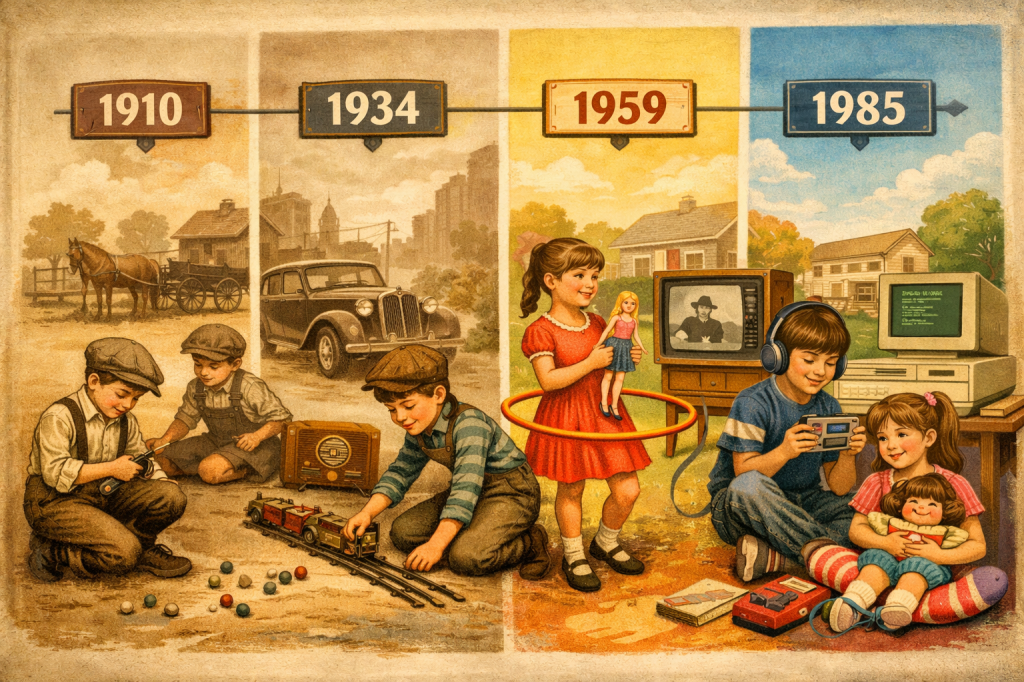
Back in December, I thought about writing a now vs. then kind of post. I never quite got around to it, so I put it on the back burner—until this morning, when it somehow jumped straight to the front.
I thought it might be interesting to look back at history through the perspective of some of my family members at age ten.
Hopefully this will be interesting. If it’s not, you’re either in for a decades-long slog… or you’ll never know this post existed at all.
So, let’s hop into our time machine.
1910
The year is 1910, and my great-grandfather James is ten years old, living in northeastern Maine. At this time, there are only 46 states in the Union. His father owns an ice company, so despite the fact that cars are still rare, the family owns a truck. They also own the house and the land they live on.
James is only a year away from leaving school so he can help support the family by working on their ice farm. When he isn’t working or studying, he likely spends his free time fishing, shooting marbles, or whittling with a pocketknife.
A typical Thanksgiving dinner would have cost less than $3, but the family would have worked far harder for it than we do today. They likely grew most of their own vegetables, and meals were prepared without any of the time-saving devices we now take for granted.
The “hot items” on James’s Christmas list might have included toy soldiers, tin wind-up toys, or—if the year had been especially good—maybe even a bicycle.
Leaving school early, working on the family farm, and walking long distances were just part of everyday life—they were simply expected. At ten years old, James wasn’t considered an adult, but he was already being trained to become one. He was expected to work hard, obey his parents, and contribute meaningfully to the family, even as he remained a child for a few more years.
Even then, the older generation worried about the younger one. In 1910, adults complained that children were being corrupted by modern entertainment. Comic papers, dime novels, and movie theaters were becoming popular, and many believed kids had it too easy and were growing lazy.
So, back into our time machine we go.
1934
The year is 1934, and my grandfather Merrill is ten years old. He lives in Everett, Massachusetts, where his father works as an oil man. His mother, like most married women of the time, is a housewife. As washing machines become more efficient, some women begin taking in laundry from neighbors to earn extra money.
The United States, now consisting of 48 states, is in the midst of the Great Depression, and many families are struggling to get by. Merrill’s family is lucky; his father is employed and has the means to help others.
Like many families during the Depression, they still grow much of their own food, especially vegetables.
The radio is becoming more affordable, giving more families the opportunity to gather around it for evening entertainment. In fact, the 1930 census even asks households if they own a radio.
Other modern conveniences are becoming more common as well: iceboxes are standard, most homes have running water, and many cars are now equipped with radios.
A Thanksgiving dinner costs under $6.00, with some restaurants offering a budget-conscious holiday meal for $0.75 to $1.25. While eating out isn’t the norm, it is an option for those living in cities or the suburbs.
Toy trains remain popular, as do tin wind-up toys. Mass-market board games, like Monopoly, are becoming available, and Erector Sets are a popular gift for young boys.
The older generation is still worried about the younger one, but the concerns have shifted. In 1910, adults feared children had it too easy. By 1934, the worry is that hard times are shaping children too quickly—and that kids now have it too hard.
1959
Back in our time machine, and jumping ahead to 1959. My mum, Nancy, is ten years old and living in Revere, Massachusetts.
While many women still stay home caring for the house and children, women are also increasingly represented in the workforce. Careers such as nurse, teacher, secretary, stewardess, and librarian are commonly staffed by women, reflecting a slow but noticeable shift in expectations.
By the end of 1959, the United States will have admitted all 50 states.
Nights spent in front of the radio give way to families gathered around black-and-white television sets. Most houses have indoor plumbing, refrigerators with freezers, vacuum cleaners, automatic washing machines, and electric or gas stoves. Life is shifting, and modern conveniences are increasingly about comfort and saving time.
Toys are becoming mass-produced and are more commonly made of plastic. Barbie dolls are introduced. Lincoln Logs are popular, as are trains, board games, and hula hoops. Bicycles are a common “big” gift for kids Nancy’s age.
Toys are starting to be advertised on television. Ads appear mainly during children’s programming and around the holidays, marking the beginning of a shift from catalogs to TV.
People are still growing vegetables in 1959, but it is no longer a necessity for survival. Families are starting to depend more on grocery stores.
Thanksgiving dinner would cost $6–$7. More restaurants offer the holiday meal, but dining out is still a treat rather than an everyday occurrence.
Once again, the older generation focuses on how easy kids have it. Food, comfort, and leisure are more readily available. Entertainment is again seen as corrupting children—this time in the form of television and rock-and-roll music. Life is changing quickly, and it is making older adults anxious.
1985
We’re climbing into the time machine for our final stop: 1985. I’m ten years old. The United States is still made up of 50 states.
Gaming consoles, color televisions, cable TV, VCRs, answering machines, and the Walkman are common in many homes. Conveniences like microwaves, personal computers, dishwashers, central heating, and air conditioning make life even more comfortable. These conveniences are readily available and generally affordable.
About 50% of women now work outside the home. Staying home with children is still considered the ideal, but finances—along with children’s ages and needs—often dictate whether a woman works or stays home.
Families are more reliant on grocery stores, so fewer people grow vegetables at home. Gardening has shifted from a necessity to a hobby.
Thanksgiving dinner costs about $25, and most families still choose to celebrate at home. More ready-made and store-bought foods are used than ever before.
The hot toys in 1985 include He-Man, LEGO sets, Cabbage Patch Dolls, and Barbie dolls. Toy popularity is increasingly character-driven and closely tied to children’s television programming. Toy commercials now air regularly throughout the year.
The older generation once again expresses concern about the younger one. Anxiety centers on screens and influence. Elders worry that children spend too much time watching TV, playing video games, and consuming pop culture. Rapid technological change makes the younger generation feel unfamiliar, and many adults fear kids are becoming overprotected, less independent, and surrounded by too much stuff.
This is the last pre-internet generation.
Long before televisions, radios, or video games, similar concerns were already being voiced. Sometime between 469–399 BC, Socrates is often credited with observing that children loved luxury, lacked respect for authority, and preferred chatter to exercise.
No matter the century—or the technology—each generation seems convinced the next one is headed in the wrong direction. Maybe being judged is simply a rite of passage. And if so, is judging the younger generation how you know you’ve officially reached middle age?
⭐ Like what you read?
If you enjoy looking at the past through a slightly crooked lens—and noticing how every generation swears the next one has it easier—consider subscribing so you don’t miss future time-machine trips. If this post made you nod, laugh, or rethink the phrase “kids these days,” feel free to share it with someone who’s said it at least once. 😉
 Brain Fog & Brilliance
Leave a Reply