It snowed earlier this week.
Not just a little snow.
A lot of snow.
Feet of snow.
In fact, just over three feet.
It’s a bit excessive.
And all Mother Nature’s fault.
Well… hers and the groundhog’s. If that little jerk hadn’t predicted six more weeks of winter, it wouldn’t have snowed and we wouldn’t be buried under almost 40 inches of it.
If you’re unsure, 40 inches is a lot of snow.
A. Lot. Of. Snow.
The part of Massachusetts I live in averages about 22 inches per year.
Yes.
Per year.
Twenty-two. Per. Year.
So who angered Mother Nature?
Probably some meteorologist. And I’m fairly certain it went something like this:
Meteorologist: “Snowfall below average the past four years… blah, blah, blah. Freezing temps… blah, blah. Possible blizzard… blah, blah. Significant impact unlikely…”
Mother Nature: icy stare “Hold my beer.”
And just like that, we got two years’ worth of snow in less than 24 hours.
Well.
She showed him.
And the rest of us.
That hardly seems fair.
If you grew up in Massachusetts, you know there is an unspoken ritual to a snowstorm.
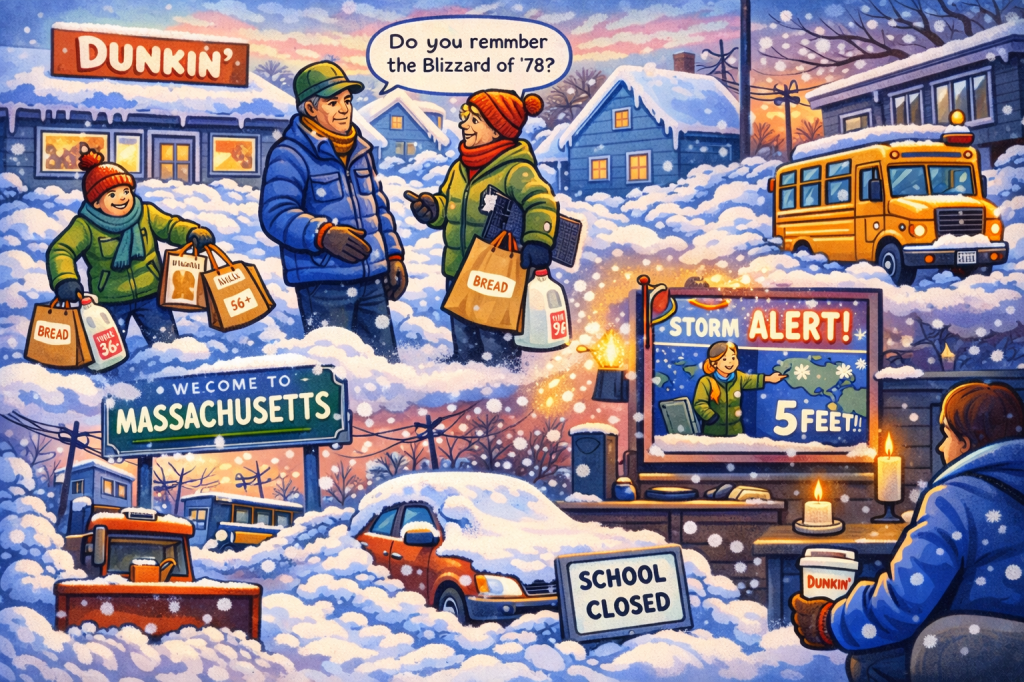
It starts with the “Storm Alert” phase.
Well, it really starts with denial.
There’s not much to say about this stage. Everyone secretly hopes it snows like hell because we all want a snow day.
But no one wants to be the one to admit it, so we all grumble about the snow instead.
When it becomes clear the storm is probably going to hit us, we shift into Snow Alert. We don’t fully commit because there’s still time to doubt.
But no matter where you go — the grocery store, the gas station, the post office — someone will lean in and say, “Did you hear?” or “Looks like snow,” or some variation of that.
It’s also common to hear deep distrust of local meteorologists:
“Channel 5 says this.”
“I don’t trust Joe Weatherman on Channel 4. He was wrong that one time 25 years ago.”
As the storm moves closer and becomes more likely to hit, we enter the Supply Stage.
During this phase, you must race to the store for “storm supplies,” which are, apparently, exclusively bread and milk.
And sometimes rock salt.
And gas.
But mostly bread and milk.
Are grocery stores even allowed to sell anything else during a storm warning?
Are we expected to survive on bread and milk for every meal?
I assume bread and milk are considered “storm essentials” because you can make sandwiches if the power goes out.
But what exactly goes in this sandwich?
Milk? More bread?
I don’t know.
I don’t think anyone does.
During the Supply Stage, you will be asked, repeatedly:
“Did you get your bread and milk?”
If you answer no, people may stare at you in horror and slowly back away.
Clearly, they are wondering what is wrong with you.
You dared to defy the Unofficial Official Bread & Milk Order.
So it’s easier to just answer yes. Because who needs that kind of judgment?
After bread and milk has been secured, we enter the Analysis Phase.
You’ll hear debates about which channel has the most accurate forecast:
“Have you seen the weather? Channel 10 is saying five feet.”
“You should watch Channel 6. They’re saying seventeen.”
And the occasional:
“Did you forget to get your bread and milk?”
“You know a storm is coming?”
It doesn’t even matter how you answer. If you are in the food store at this point, people will assume you ignored the bread and milk mandate.
Or it’s possible you just look like the type of person who would ignore the need for storm supplies.
By this point, we are well beyond the Supply Stage.
Shop at your own risk.
Store employees may mutter, “Wow,” as they pass you in the aisles.
Their tone suggests serious incredulity.
And mild concern.
Possibly even a character flaw.
No one actually has to ask what’s wrong with you.
It’s already implied.
Failing to secure bread and milk in a timely manner is a serious moral lapse.
For those who didn’t grow up in Massachusetts — or even New England — this is the point where people begin to drive like a 7-year-old playing Mario Kart.
If you’re unfamiliar with that reference, don’t worry about it.
Just trust me, it’s terrifying.
And if it’s the first snow of the season, even native Massholes have been known to temporarily forget how driving in snow works.
We are not proud of this.
But we do recover.
Usually by the second snowfall.
There’s another part of the snowstorm ritual that can appear at any stage, and that’s the “When I was…” story.
“When I was a kid, we walked uphill both ways in the blizzard wearing only flip-flops and a scarf.”
“When I was working at XYZ Company, we drove through three feet of snow and the wind was so crazy I watched the car in front of me fly right off the road. Right off the road.”
And if you’re a true New Englander, you are legally required to mention the Blizzard of ’78.
That story usually begins with:
“Do you remember the blizzard…”
Do not make the rookie mistake of saying you don’t remember.
Even if you were two and a half.
Even if you weren’t born yet.
Memory of that blizzard lives in your DNA.
These stories must be delivered in a wise, nostalgic tone — preferably with the air of someone who is older than snow itself.
Finally, after all that preparation…
The storm hits.
Everyone hunkers down.
Except that one Masshole who feels compelled to “test the roads” or make a “quick run to Dunkin’.”
Once the first flake hits the ground, a new phase begins:
The Plow & Power Watch.
You call — or text, or message, or send a carrier pigeon — under the guise of:
“You doing okay?”
But what you’re really asking is:
“Do you still have power?”
“Has your street been plowed?”
“How bad is it over there?”
“You have a bed free?”
“And will you come get me if I need that bed?”
All of that is somehow contained in that one innocent little question:
“You doing okay?”
If the storm hits Monday through Friday, there’s one more critical discussion:
“Do you think the kids will have school tomorrow?”
This will be followed by a detailed, completely unqualified analysis of:
Snow totals.
Plow status.
Previous storms.
And that one time in 1997 when they closed schools and it didn’t snow at all.
Once the snow ends, the cleanup — and the complaining — begin.
Between updates about losing power and hot water, there is shoveling.
And clearing off cars.
And the all-important Dunkin’ run.
As electricity is restored, the conversation shifts again:
Who has power.
Who doesn’t.
Who hurt their back shoveling.
Who hired the neighbor’s kid instead.
Whose street has been plowed.
Whose hasn’t.
But it doesn’t snow every time it’s forecasted.
Sometimes it rains instead.
And sometimes it does nothing at all.
Which leads directly into:
“This is why I never trust Channel 9.”
“I told you Channel 4 exaggerates.”
“They said five feet!”
And just like that, the ritual resets.
Until the next time the weather person says,
“Keep your eye on this one… it could be a big one.”
If you’ve ever panic-bought bread and milk or debated school cancellations like a meteorologist, this one’s for you ⭐ Share with your favorite Masshole.
Love witty takes on modern life — with a strong New England accent? ⭐ Subscribe so you don’t miss the next ode.
 Brain Fog & Brilliance
Leave a Reply